Sunday, January 26, 2014

I have always loved falafel, or taameya as they call it in Egypt, but I wanted to find a way to make it without deep frying. Well, the last time I published the Egyptian Falafel Recipe; I had frozen several packages of falafel. So I decided to try baking one of the packages. Let me tell you I could not have been more pleased, not only does it taste the same as fried falafel, it is also much easier to make with much less mess and no frying odor. With this recipe you gain the health benefits of lower fat, the ease of cooking, and you do not give up any taste.

If you notice a similarity between the steps in this recipe and the Egyptian Falafel Recipe, it is no coincidence. I used the same batch to make both the fried recipe and the baked recipe

Egyptian falafel, or taameya, is different from the garden variety falafel that you usually get in this country. The difference is that the Egyptian variety are made with fava beans instead of chick peas(Garbanzo beans). Fave beans have a much richer flavor and are higher in protein and fiber than chick peas. If you can't find dry fava beans, you can use dry chick peas in the same quantities as this recipe. 

Falafel and fava bean sandwiches are the original fast food and are available at many corner stands throughout the Middle East. They are a delicious, economical, and extremely healthy main course choice.

This dish is an awesome vegetarian treat that will leave you completely satisfied. Serve it with Tahini Bagdoonisya dip, Baba Ghanoujyogurt sauce, and cut vegetables.  My favorite way to enjoy it is on Arabic bread with tomatoes, cucumbers, lettuce and Tahini Bagdoonisya dip'

You can also freeze the uncooked mixture for 6 months and cook it as you need it.  

Ingredients
  • 2 cups fava beans, peeled if possible. You can buy this at any Middle Eastern market. If they are not available peeled, you can peel them after soaking, or keep the peel for additional fiber.
  • 1 fresh leek, washed and sliced.
  • 1 bunch (6 stalks) green onion
  • 1 bunch fresh Italian parsley
  • 1 bunch fresh cilantro
  • 1 head of garlic
  • 2 tbsp ground cumin
  • 1 tsp ground coriander
  • 1 tsp cayanne pepper, double the quantity for Alexandria style.
  • 1 tbsp baking powder
  • 2 tsp sea salt (can be omitted or reduced for health reasons, it will still taste good)
  • 2 tbsp olive oil

Directions

Prep the Beans:
  1. Wash the beans thoroughly in luke warm water.
  2. Soak the beans in water for at least 2 days, changing the water about 4 times during this period. The first water changing should come when the beans form a foamy froth on the surface. Changing the water will prevent the beans' gassy effect on your GI tract.
  3. Drain the beans when ready to make the paste.

Make the Paste:
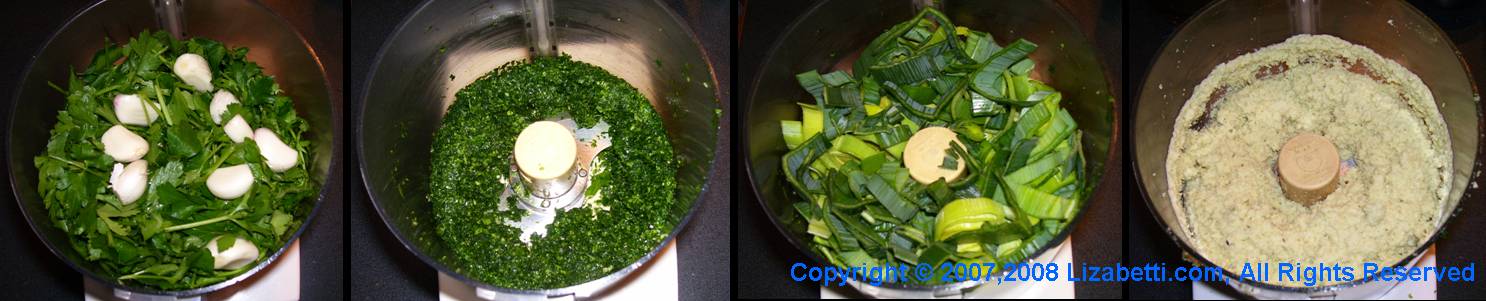
  1. Place the parsley, cilantro and garlic in the food processor, chop fine.
  2. Add the green onions and leeks, chop fine.
  3. Remove the vegetable paste from the food processor and set aside. Do not wash the food processor.
  4. Add the beans to the food processor and chop until they reach the consistency of a thick peanut butter.
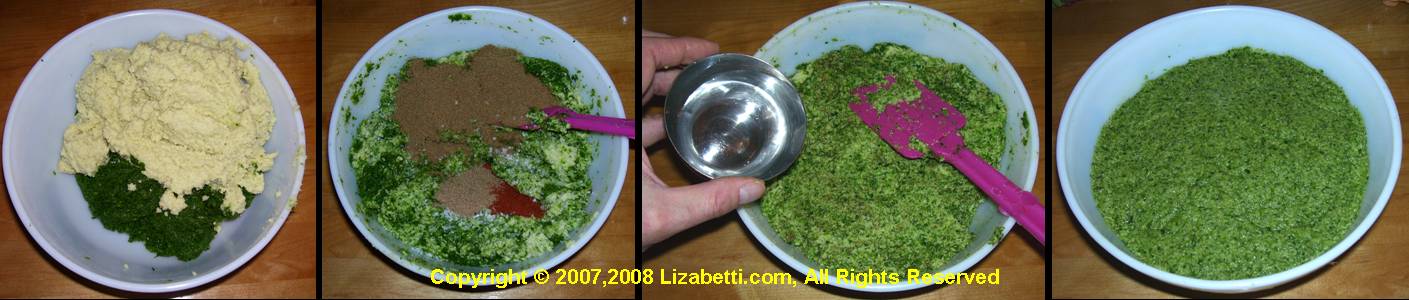
  5. In a bowl, mix the vegetable paste and chopped beans.
  6. Add the cumin, coriander, cayanne, and salt. If you are going to freeze the mixture, leave out the salt and add it when you are going to cook the falafel.
  7. Mix the ingredients thoroughly and stir in 1/4 to 1/2 cup of water. Mix the paste thoroughly.
  8. Sprinkle the baking powder over the paste, evenly fold into the paste.
  9. Let stand for at least 1 hour. You can also leave it covered in the fridge over night.
  10. If you want to freeze the mixture
    Remove all air from the bag. I prefer to vacuum seal mine. If you vacuum seal them they will last at least six months in the freezer. I have have used them after 1 year in the freezer with no problem.

    • Divide into 1 pound (1/2 Kg) portions
    • Place each portion into a plastic freezer bag and flatten to a 2 inch (5 cm) thick patty. Flattening them makes them faster to thaw out later.


Bake the falafel:
  1. Preheat the over to 400oF (204oC).
  2. Lay down a sheet of baking paper over a cookie sheet.
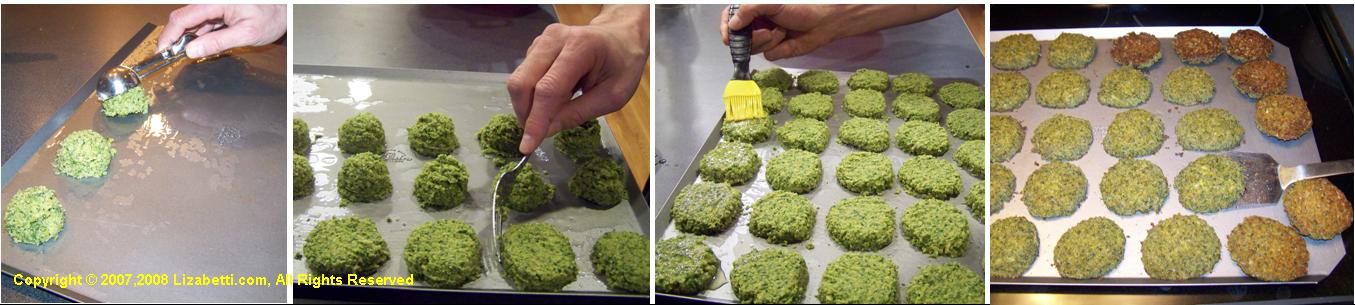
  3. Use a small ice cream scoop (1 Tblsp size) or a spoon to form small balls of your paste. Space them evenly across the sheet.
  4. Flatten the balls into disks with a fork. Be sure to pat the sides in smooth so they don't burn. 
  5. Brush the top of each patty with olive oil.
  6. Bake at 400oF (204oC) for 10 minutes.
  7. Slowly slide a thin spatula under each patty and flip. This is easier if you take the sheet out of the over first.
  8. Bake at 400oF (204oC) for another 10 minutes.
  9. Serve hot or cold.

I realize that it looks lengthy, but the work portion of it can be done in 45 minutes. You just need to plan ahead for the soak time for the beans and the stand time for the paste. If you freeze this mixture, you can enjoy this tasty treat anytime without too much effort, even on a week night.


Copyright © 20014 Lizabetti.com, All Rights Reserved


Copyright © 20013 Lizabetti.com, All Rights Reserved

Saturday, December 17, 2011

Tasty Baked Kibbe (Kobeiba Shamy)


This is one my favorite dishes that Gedo makes.   There are probably endless variations to this dish, but I love this version.  Not only is it great the day you make,  the leftovers freeze really well.  We enjoy eating the kibbe with a little yogurt dip and hummus.  It is great as a lunch leftover since it can be served at room temperature.

This dish is also very healthy because the burgul wheat is high in fiber, it is baked so it is low in fat. It is also very economical because the wheat helps to stretch the meat.

In Egypt, this dish is called Kobeiba Shamy. It is named after an ethnic population in Egypt, the Shamy people,  who originated in Lebanon, Syria, and Jordan. The Shamy people are famous for their delicious dishes, which are distinct in style and flavor from other Egyptian foods.

Now Gedo is actually from Jordan, so his style of making this dish is very authentic.


Ingredients:

The crust layers

  • 1 lb of ground lean ground beef
  • 2 cups of burghul #2 (Bulgur wheat)
  • 1/2 tsp salt
  • 1/2 tsp of black pepper
  • 1/8 tsp of allspice
  • 1/4 cup of pine nuts
The meat filling
  • 2 lbs coarsely chopped lean beef
  • 2-3 medium size onions
  • 1/2 clove of garlic
  • 1/2 cup of coarsely chopped parsley
  • 1/2 tbsp of salt
  • 1/2 tbsp of black pepper
  • 1/2 tbsp of allspice
  • 1 tbsp of dried oregano
  • 1/4 cup of olive oil
  • two 9 x 12 baking dishes


Directions:
  1. Rinse and soak the burgul wheat for about 30 minutes in lukewarm water.  I like to use the #2 burgul because it is coarse giving the dish a nice texture.  Gedo uses the finer burgul.  This is just a matter of preference.
  2. Trim and coarsely chop the lean beef. 
  3. Set the beef on a paper towel which will help to soak any liquid from the beef.  This will ensure that the beef brown nicely, rather than be steamed in its own juices.  Set the meat aside.   If you are short on time, you can substitute this ingredient with ground beef.
  4. Coarsely chop the onions.Clean and trim the parsley. 
  5. Coarsely chop the parsley.
  1. Finely chop the garlic.
  2. Preheat the oven to 400 F.
  3. Using a large sauce pan, heat it on medium high.  Add 2 tbsp of olive oil and brown the coarsely chopped beef.
  4. Mix in the salt, pepper, oregano and allspice. 
  5. Once the meat is nicely browned, add the chopped onions and garlic.  Cook them for a few minutes, until fragrant.
  6. Drizzle 1 tbsp of olive oil into the beef mixture.  Mix the parsley in and cook until the parsley is wilted.  Remove from the heat and set it aside.   


  1. Drain the burgul and place in a large container.  Add the ground meat and the salt, pepper and allspice for the crust.  Now for some fun.  You need to thoroughly incorporate the beef with the burgul.  This is best done using your hands.  Kneed the mixture with your hands until it is completely mixed together.  It should have the consistency of dough.  Divide the mixture into approximately 4 portions.  Two of the portions will be used for the bottom layers and 2 will become the top crust for the dishes.    
  2. Drizzle about 2 tbsp of olive oil into each of the 2 baking dishes.Take 1/4 of the crust mixture and press into each of the baking dishes.  Use your hands to work the mix into a nice even bottom layer.  There should be no gaps in the layer.
  3. Diviide the cook meat mixture between the 2 dishes.  Spread it even over the dishes.
   

  1. For each of the top crust layer, take a small quantity of the mixture and form a flat patty with your hand.  Careful place it on top of the other layers.  Continue until you have cover the entire dish.  You will have small gaps as you cover the layers with the final crust.  Repeat this process for the remaining dish.
  2. Fill a small bowl with water and wet your hand.  Take your wet hand and careful smooth the top layer of the dish until all the small gaps have been fill in.  Do not press hard.  It should be a gentle smoothing over.  Continue doing this until you have a nice smooth top layer.
  3. Using a sharp knife, first score the dish into 3 lengthwise sections and 4 crosswise sections.  When you are satisfied with the size of your sections, Cut the sections all the way through.
  4. Place a few pieces of pine nuts onto each portion.  Gently press the nuts in.
  5. Bake for about 30 minutes in the oven.  You will know that the dish is done when the top becomes a nice golden brown.  
  6. Cool for about 10 minutes and serve with yogurt sauce and hummus.
  7. One of the dishes will generously serve 4-6.  The other dish can be refrigerated or frozen.


See All of Our Recipes


Copyright © 2009 Lizabetti.com, All Rights Reserved


Friday, April 9, 2010

Latino Lasagna AKA Taco Casserole

This dish is one of my favorite ways to use up leftovers. This is a variation on Lizabetti's Light and Healthy Enchiladas and it is made from leftovers from Lizabetti's Healthy Tacos. While the dish is similar in concept to the enchiladas, but the different shape gives it a whole different taste and texture.  We used to make this dish in college, but then we just called it "Taco Casserole". It is a very satisfying and filling dish and still very healthy.

This meal makes a great weekday dinner and and is a perfect work lunch the next day. I got several lunches out of the one meal, I guess you call that second order leftovers. It also heats up very well in the microwave without losing flavor.

I like to serve it with guacamole, sour cream, and fresh salad greens. For a little extra zing, also serve some of the warm sauce on the side . I also highly recommend that you go with corn tortillas for a more authentic Mexican taste. 

Like all leftover recipes, the ingredient quantities are just a guideline, you should use what you have.


Ingredients:
  • 8 oz Taco meat from the Healthy Taco Recipe
  • Spicy black bean dip, I like Trader Joe's, but you can use leftover refried beans as well.
  • 8 oz shredded sharp cheddar
  • 2 cups Left over (or fresh) Chunky Salsa
  • 1 14 oz can of diced tomatoes.
  • 1 Pinch cayenne
  • 1 Pinch chili powder
  • 1 Package high fiber tortillas or corn tortillas. You can also use the left over taco shells from the tacos.
  • 1 Cup cooked rice. Usually I have some left over in the fridge.
Directions:
Sauce:
  1. Place the Salsa and diced tomatoes in a pan
  2. Simmer on low until tomatoes are soft, about 15 minutes.
  3. If desired, add cayenne and chili powder.

Construction:
I like to use a heavy Creusete baking pan, you can also use glass, ceramic, or metal.
  1. Pre-Heat oven to 375 oF(191 oC).
  2. Place a thin layer of sauce on the bottom of the pan. This will prevent sticking
  3. Cover the bottom with tortilla shells. Cut them to shape to ensure that you cover the entire bottom.
  4. Place a layer of the bean dip.
  5. Place a layer of rice, followed by a layer of meat.
  6. Add a layer of cheese and top with another layer of tortilla's.
  7. Add another layer of sauce and top with the rest of the cheese.
  8. Bake for 45 minutes at 375 oF(191 oC).

Copyright © 2007-2010 Lizabetti.com, All Rights Reserved

Monday, March 29, 2010

Red Saffron Makes Red Rice

This is my my daughter's favorite rice dish. She likes the brilliant red color of the rice as well as the nutty, fragrant saffron flavor. It is a common side dish for many of our holiday feasts. In our family we look for any excuse to have a feast and this dish is an easy way to brighten it up.

To get this color you must have the right type of saffron. I got mine when I was visiting Luxor, Egypt as part of a Nile cruise.  Only the dark red saffron will give this color, however regular saffron gives a yellowish orange color which is also quite appetizing. You can probably get it in a Middle Eastern market or a gourmet shop.  
This side dish is served with many of the recipes on this site, partially for its looks, but also because we love the taste. It goes great with Middle Eastern dishes, but can be served with just about anything. Here are some dishes with which we serve this rice.
Ingredients:
  • Two Cups Jasmine Rice
  • 1 Teaspoon Red Saffron 
  • 2 tsp Chopped Garlic
  • 1 pat butter
  • 1 tsp olive oil
  • 1 tsp salt
  • 2 Cups beef, chicken, turkey or lamb stock. Choose the stock to match the meal. Use water if you are vegetarian, it works fine.

Directions:
  1. Heat the pan to medium-high heat and add the butter and oil. 
  2. Heat until the butter melts and just begins to sizzle.
  3. Add the rice and fry in the butter/oil mixture.
  4. Add the saffron, salt and garlic. Mix in thoroughly.
  5. Add the stock or water, stir.
  6. Since the rice is hot, the stock will probably come to a boil almost immediately. Otherwise bring it to a boil.
  7. Turn down the heat to low (about 2.8) and cover.
  8. Cook until all the liquid is absorbed and the rice no longer makes a simmering sound. About 15 minutes.
  9. Turn of the heat and let the rice stand covered for about 10 minutes to absorb the steam.
  10. Stir the rice so that the red color is uniformly distributed.

  
Copyright © 2007-2010 Lizabetti.com, All Rights Reserved


Tuesday, March 23, 2010

A High-Tech Workday in Japan - Part II

In Part I of this article I told you how we commuted across the country by air to arrive at this Japanese computer chip factory. The factory is called a "Fab", which is short for fabrication plant. Factories that make multiple types of chips for outside customers are called foundries.

My client owns its own fabs, but also outsource some of their production to foundries in Taiwan. Yes, the Japanese also look to cut labor costs by off-shore production.

In the last installment I had checked in at the guard shack and was issued my zip-lock bag of accessories.
  1. A large blue plastic bag
  2. a badge
  3. Various instruction manuals in Japanese
  4. A locker key
  5. Some other items that I had no occasion to use.
As we entered the complex, which is several square miles and many buildings we saw several gigantic robotic vehicles carrying materials between buildings. These moved very slowly and played pleasant music to warn off human pedestrians. I thought that the music was a nice touch over a claxon, or some warning message like "Dear Human, Please Avoid this Giant Robot or it Will Crush You".

By contrast we passed a small rock garden with a lovely waterfall and Bonzai trees. I would have liked to linger because the scenic mountains were visible from this spot, but we had a busy day ahead.

We walked about 200 meters and turned left into an unmarked door. This led to the customary shoe check station. No fab in Asia will allow you to enter wearing street shoes. They do not want street dust brought into the building. So we each put our shoes into a cubby hole and went to the shelf for a pair of slippers. This fab had snappy looking clean white slippers, the largest of which was about USA size 11. I wear size 12, so it was a tight squeeze into the largest pair. My American colleague is about 6'8", so he was even more uncomfortable as he squeezed into a size 11.

We then went through a pair of air-tight double doors into a locker room. As we entered we passed shelves that had various sizes of pajama like garments. I tried to select the blue pajamas, but was told that vendors had to take the beige colored version. We each took a top and pants and headed toward the lockers. We hung up our street clothes and donned the beige pajamas, we used the locker key to lock the locker with our clothes inside.

Now you know why it does no good to wear a business suit. No one will ever see it. The customer will only see me in my drab beige pajamas and too-small white slippers.

The large blue plastic bag was for any items that I needed to carry into the fab. The bag keeps dust from spreading as one is walking toward the work area. This was difficult for me as I carry lots of computer equipment and I need all of it. So here are the things that I stuffed into the blue plastic bag:
  1. My laptop computer
  2. Extra battery
  3. AC Power adapter + Japanese plug converter
  4. An attached hard drive
  5. A network switch
  6. A USB thumb drive
  7. My lab notebook (taking careful notes is very important in this line of work)
As you can guess this made the bag very heavy and awkward to carry. Little did I know how far we still had to walk. Remember that these factories are huge and one must pass through multiple buildings to reach the place of work.

We walked the length of one building, went down some stairs, walked down the hall, climbed some other stairs, took a left, walked the length of another building and boarded an elevator. We must have covered at least half a mile total. We walked some more and then took another elevator and finally arrived at a very important place. The fab cafeteria.

Besides being used to serve meals, many people use the cafeteria as a work space and informal meeting spot. It is also one of the few spots with windows to the outside. The view of the mountains was spectacular from here and if you sit near the window you get cell phone reception. Cell phones do not work in other parts of the building unless they are the special fab issued mobile phones, which the customers all carry.

We called our customer's cell phone and he appeared in the cafeteria in a heartbeat. I don't know how he did it, but every time I called this guy, he appeared at my side instantly. It was convenient because every time I needed him I just called a number and he showed up.

We sat down in the cafeteria with the customer and his boss and discussed the goals for the day. All conversation was in Japanese with periodic translation for my benefit. Since they were discussing a subject matter that I am familiar with, and it is peppered with English technical terms; I could usually discern the gist of the conversation even if I do not speak Japanese. However I was careful to not assume that I understood. K-San would explain some of the nuance of the conversation as well as the literal translation. Sometimes one has to ask for additional translation because sometimes the Japanese guys will forget that the Gaijin does not understand them.

We were escorted through a large room, probably 40,000 square feet that was full of desks side by side, but no cube partitions. The people were all working industriously. As we walked through it struck me that all the male employees were wearing blue pajamas and the female employees were wearing pink pajamas, very cute. The supervisors were wearing black pants with dark red jackets. Of course everyone wore the snappy white slippers. Everyone looked very comfortably dressed, and now I understood why I could not wear blue pajamas, I would be mistaken for an employee. You the pajamas also serve as uniforms complete with insignia. Outsiders wear beige.

We went into a slightly smaller lab and installed in a corner. We were told that we could set up our computers on the right side of the aisle, but not to encroach on the left side. At this point we had our marching orders and we set about to work.

We worked until about 6PM at which point K-San informed me that he had a meeting at 8 PM and would I like to have dinner first? I agreed with the plan since I had done as much as I could for the day and would need to meet the customer again to move forward.

We checked into our hotel. I asked for a non-smoking room and the desk clerk got very apologetic. He politely said that they had no non-smoking rooms. I could not figure out if he meant never or if the rooms were all taken. He asked me to smell the room and call him if I could not stand it.

The hotel was clean and attractive and displayed a large copper ingot in the lobby, which I learned was a native product of the region. When I got to my floor I found that the hall smelled of smoke but I was relieved to find that my room smelled fresh and smoke free. I opened the window and found that my view was of a shopping mall, but behind it I could see the mountains.

We walked to the shopping mall for dinner and found a good selection of restaurants there as well as huge grocery store. My colleagues wanted to eat Italian food, or I should say the Japanese interpretation there-of.

I had a spaghetti like dish with tomato sauce and topped with sautéed eggplants. K-San had the egg-rice, which is a semi-spherical mound of rice perfectly molded in to an omelet. In the usual Japanese fashion, the restaurant was very clean and the service was prompt and courteous. The food was pretty good, but did not really taste Italian at all.

The big mistake was ordering garlic bread. It looked and smelled like garlic bread, but that was where the resemblance ended. Imagine if aliens were able to measure looks and smell, but not the taste of human food. This is what they would produce. All I can say is this stuff tasted strange and felt strange going down.

On the way back we stopped at the grocery store to buy water and snacks. I could not resist buying the chocolate macadamia candies, some beef jerky and some wasabi chips. Japanese junk food is very good. Even if you don't like Japanese food, you can survive on the junk food. Just make sure to eat a fruit once in a while.

The next morning I woke up early, did my exercise routine and went up to the breakfast buffet. The breakfast was mostly traditional Japanese which included fish, rice, and soup. The soup was orange in color and the flavor was vaguely familiar. After some time I realized that it was a pumpkin soup. It was very smooth and tasted like pumpkin. I was careful not to eat too much at breakfast (or any meal) because I am not used to the food and my body clock is all confused due to the 14 hour time change. When traveling in Asia, the key is to eat just enough to survive because you never know how or when your body will react; and you do not want any embarrassing situations on customer site. Some other time I will tell you about my colleague YK and his embarrassing situation in Taiwan.

We went back to the factory and went through the same security check in and dressing procedure as the previous day. I had solved some of the problems I encountered the previous day, so we made progress without serious mishap for the entire morning. As I was working, K-San alternated between going to the cafeteria to download his email near the window, studying technical manuals and preparing power-point presentations. Even though he was here to help me get around, he still managed to make progress in his normal job. Very impressive.

Around lunchtime, certain musical sounds are played over the public address system. I did not know what these meant and I happened to go to the restroom about the time one of these tunes were played. Ignorance in this case was not bliss because it was time for the first shift of lunch to approach the cafeteria. As I made my way down the hall I encountered a line of pink and blue humanity marching two abreast in perfect step toward cafeteria. There must have been close to 2000 people coming down the hall and I felt like a salmon swiming upstream. The hall was narrow and there was no room for me to move in the opposite direction. I finally gave up and waited in the cafeteria until the first wave dissipated. I then hurried back to my work area.

K-San was hungry, but he found that we could not eat lunch in the cafeteria because we had not reserved in advance. So we walked the half mile back to the exit, hung up our pajamas, put on our clothes and left the facility.

We drove to a nearby restaurant that served most of the common Japanese fare. Out front there are realistic looking models of the food to help you decide what to have. I decided to have the Curry Oodon noodles. These are long, fat, round noodles in a rich curry sauce with some sort of meat. It is really a delicious dish if you like curry, which I do. It is almost a noodle soup because you get so much of the curry sauce. It is really a comfort food for me. I sprinkled some red pepper on the dish, which K-San found surprising.

Fully re-charged, we headed back to the fab, donned our pajamas and completed our workday. At the end of the day we were joined by one of our Japanese sales managers and we went out to dinner.

When we were discussing dinner plans, they asked me if I wanted to eat at Big Boy, the American chain. I thought they were joking because I would not ever eat at Big Boy in the USA. It turned out they were serious, I guess that food is a novelty for them.

However we decided to go to a Japanese fried pork restaurant and I could not be happier. I ordered a combination platter that included a breaded fried pork cutlet and several fried prawns and some fried oysters. I was given a mortar and pestle with toasted sesame seeds and instructed to grind them up. Then a brown tangy/gingery sauce is added to the sesame. This is used as a dipping sauce for the meats.

K-San pointed out to me that the sign said (in Japanese) additional rice and cabbage at no charge. This pleased me greatly because I always like to keep up my intake of vegetables. The cabbage is really a seasonal salad, it is topped with a vinegary/sesame dressing. I found the cabbage quite refreshing and had several helpings.

We put in one more half day of work and met all the goals of our trip.

Before traveling back to the airport we stopped for lunch at a Ramen Noodle Restaurant. The Japanese people always call the Ramen noodles Chinese noodles. This was my favorite place so far because they had a very spicy noodle dish with an almost Korean flavor, in fact they served kimshee as well. The noodles were in a red pepper flavored soup with pieces of meat mixed in and various vegetables that I did not recognize. The soup was delicious and the noodles looked like thin spaghetti noodles.

For side dishes I ordered Gioza, which is very similar to the Chinese dumplings. I also ordered Ee-Ka, or fried squid. The dumplings were great and the squid was fresher than any I have ever eaten, imagine the best possible calamari, only fresher.

We drove back to the airport and still had some time to kill before boarding. There was a huge model dragon in the airport lobby and a food store that was offering free samples. Even though I was full, I sampled some of the interesting fare of the region.

K-San is a frequent traveler so we entered the first class lounge with his card. Inside they offered beer, wine, fruit juices and various snacks. I was too tired to drink alcohol, so I had several glasses of tomato juice.

We boarded the plane and I passed out the minute it was in the air and awoke as we were landing in Tokyo Haneda airport.

K-San escorted me to the Haneda airport hotel where I would spend my last night in Tokyo before traveling home. The hotel was great just like all the others. I took advantage of all the amenities, had a scotch and some soup noodle for dinner and went to bed early. I did not even check my email.

The next day I went home. A good trip but boy was I tired.

Please tell me some of your travel stories by using the Comment link below

Monday, March 22, 2010

A High-Tech Work Day in Japan - Part I

After my weekend in Tokyo I was well prepared to get back to work. I thought you might be interested to know what a high tech professional does on a typical workday. My workday was a bit super-typical, meaning that it was a bit more high-tech and further reaching than a person may do on a normal day. However, I have observed that it is not unusual for a Japanese salary man to take a commuter flight across the country, visit an electronics factory and fly back in time for dinner. In Japan it is possible to travel everywhere with mass transit, and the airlines are  part of that.

I also thought it may be interesting for you to read about life in a semiconductor factory, also known as  a fab.  This is where computer chips are manufactured. All of us use computers, but few of us get a glimpse of how they are made.

I checked out of my hotel bright and early and headed for the Hamamatsucho mono-rail station. I was going to take the mono-rail to meet my colleague, K-San, at Haneda airport to begin our travels. Since I had practiced the route numerous times I made it in 10 minutes. The ticket machine was exactly where the web site said it was and I was relieved to find a button clearly labeled "English". I was a bit worried that there was no way to get a receipt for the ticket, which cost about 470 Yen, or $5.

I fed my ticket into the machine by the entrance which gives you a nice green arrow to proceed and gives you the ticket back to use for exiting the destination station. I got in line and noticed all signs were in Japanese, so I had a momentary anxiety that I might be boarding the wrong train. So I asked the gentleman in front of me "Smee-ma-sain, Haneda?" (excuse me, Haneda), while pointing at the mono-rail car. He understood and said "Hai" (yes). So I reponded "Arogato dai mas" (thank you very much). 

Even though I was proud of my fledgling language skills, after I boarded the train I realized that it was impossible to board the wrong train at this station and there are no branches in the monorail line. So the question was totally unnecessary and the guy must have thought what a dumb gaijin (foreigner) I was. 

On the train I was pleased to see that there was a luggage rack where I could put my suitcase. The train was full of salary men, professional Japanese men, all dressed in blue suits and ties, standing room only. I was impressed with the beat of the city going to work and realized that in cities all over the country the same scene was taking place. I felt a trace of envy that the mass transit system was so good. I have had jobs where I could use mass transit in the USA, but it is not as widely available as it is in Japan.

I was mildly uncomfortable because I was casually dressed, but in the past I would wear suits to work in Asia. I found out that it did not do any good to wear business suits in the semiconductor industry. I will explain why later. 

As I was leaving the mono-rail station I wanted a receipt since I knew that the machine would eat my ticket on the way out. Lizabetti is very strict about expenses and every penny counts. So I went to the booth by the exit and asked the uniformed employee "smee-ma-sain, resheeto kodo-sai?" (excuse me, may I have a receipt?). He stamped my ticket, so that was my reciept, and ushered me through the gate. I was quite pleased with myself since that was $5 I would not have to eat.

I arrived early at Haneda airport, which was good because I still needed to get some breakfast. I walked around the airport and saw various choices, many of them good. The airport had many regular Japanese restaurants, McDonalds, and a cafeteria style bakery called Vie de France. The bakery had just put out fresh breads and the smell was fabulous. So I opted for that.

I know that Vie de France is an international chain, but the selection at the Haneda airport store was decidedly Japanese in flavor. I grabbed a tray at the head of the line and selected the foods that had just been put out since I stepped into the store. Freshness is a good policy when selecting food.

  1. First I saw a large version of "Piggies in a Blanket". Basically a natural casing frank baked into a piece of bread. The bread was fresh and warm and the hot-dog was well cooked and firm.
  2.  The next thing that came out was very Japanese. A cluster of baked noodles wrapped in a pancake.  This was pretty good too, the noodles were flavored in a Japanese manner with light soy-ginger taste.
  3. The final thing that caught my eve was the Japanese version of "Piggies in a Blanket". This was a tempura vegetable baked in a bread wrapper. Also very good.

I grabbed a cup of coffee to go with the above fare and went to look for a seat. I noticed that there was only one seat left at the non-smoking counter. As I squeezed into it I bumped the man next to me. He gave me a murderous look, but I said "smee-ma-sain" (sorry) and he smiled and nodded. As K-San had told me, this is a very useful word. The breakfast was delicious and the coffee was good too. 

I met K-San right on time under the number 6 clock in the departure level, he was prompt as usual and looking dapper in his salary man suit. We checked our bags and went through security, which was much more efficient and courteous that U.S. airports, and passed into the departure lounge.

Once we were in the departure lounge he mentioned that we should buy lunch to eat in the air since we would still by flying at lunch time. We stopped at a small store which offered a variety of reasonably priced meals. The selection included various Bento boxes containing sushi, pork sandwiches,  hamburgers, rice balls, chips of all kinds. I opted for a pork sandwich in a box, a beef rice ball and small box of potato crisps.

We boarded the plane. The crew was very pleasant, well dressed and attractive. They offered beverages several times including a very tasty lemonade drink. Around noon I decided to eat the lunch I brought aboard. 

I ate the rice ball and saved the rest for later. The rice ball was a triangular block of rice wrapped in seaweed. In the center was some cooked beef with light spicy-soy sauce taste. It was quite good and did a good job of stopping my hunger.

The plane arrived in Matsuyama right on time. We met another colleague at the airport and took the rental car bus to our rental car. It was poring rain and I was thankful that I kept my $4 umbrella as I was waiting for K-San to complete the paperwork for the car. We boarded the car and drove toward Niihama, about a 1 hour drive.

The scenery was very beautiful along the way. There were mountains along both sides of the road and fog in the valleys in between. The mountains were covered with evergreens. Occasionally we would see an orchard on the mountain-side.

Our second colleague, had not had lunch, so we split the pork sandwich and potato crisps. The pork was pleasant with a sweet-spicy taste, something like BBQ. The potato crisps were lightly salted and had full potato flavor.  However my colleague was still hungry so we stopped at a rest stop where he had a meal. I got myself an ice cream novelty, similar to a Nutty Buddy.

As we got close to Niihama, the scenery continued to be beautiful. You could see the mountains on the left and the Seto sea on the right. I found most of the buildings bland, but they did no harm to the scenery. Niihama is an industrial city so little attention is paid to aesthetics. 

Pretty soon we arrived at our client electronic company, it was still raining, but we knew that we  would be indoors for the rest of the day. The company was near the sea port and we could see giant gantries from the parking lot. 

We approached the guard shack and K-San filled out the admission forms and we were each issued a plastic zip-lock bag containing:

  1. A large blue plastic bag
  2. a badge
  3. Various instruction manuals in Japanese
  4. A locker key
  5. Some other items that I had no occasion to use, so I forgot them.

In my next installment I will tell you about life in a typical Japanese electronics factory and you will see why it does no good to wear a business suit.

Sunday, March 14, 2010

River's Weekend in Tokyo - Part II

This morning the weather went from crappy to extremely crappy. Cold, wind and hard rain conspired to keep me pinned in my hotel room with the Jewel of the orient just outside. There were Tsunami warnings broadcast on the PA systems. However, I really wanted the cleaning crew to clean my room, and they won’t do it while I am there.


Undaunted, I decided to be a foul weather tourist and see if I could avoid getting lost today. Now that I know my hotel is really facing the other way I have been able to find all kinds of stuff.
A little web research revealed that the Tokyo Tower, the worlds tallest free standing steel building, was constructed beginning in June 1957. Certainly with an auspicious initiation date like that I had to visit it. Knowing that the tower and I are exactly the same age, I wanted to see how the old girl was holding up. The Tokyo tower is in the same style as the Eiffel Tower, but in typical Japanese fashion it has all kind of electronic communication equipment mounted on it.
Today I figured the chances of getting lost were much less since the Tower is really tall and you can see it from a distance. Of course I did not count on the fact that sometimes events are bigger than the plans of a single individual.


I planned my route carefully having learned from yesterday’s mistakes. So with my 400 Yen umbrella in hand, I was on my way. In spite of the pouring rain, all along the way I saw the landmarks I expected, so far so good until I got halfway there. In the distance I saw a large number of people running at what seemed like extreme speed to me. The road was blocked off for cars and I saw several thousand people running in the rain down the middle of the road. There was also loud Japanese Superhero type music playing and there were several hundred people dancing in the rain, all in sync with each other. The total bedlam was inspiring to me as I had been resenting having to walk in the rain, when I saw all these maniacs, I must say it gave me a lift.


It turned out that I ran into the Tokyo Marathon 2010. Let me just say that this was no ordinary marathon. As we all know Japanese people love to play dress up and this was no exception. A large percentage of the runners were in costume. There were several Darth-Vader’s, tons of Pika Chu’s, at least 5 Santa Clauses, a guy with multi-colored afro, a lot of old men running with trash bags on their head, and many, many characters of all kinds. The amazing thing is that almost all of these costumed avengers were running 7 minute miles or better.


Imagine the frustration of the runner who is losing to Santa Clause!
Anyways I stuck around for a while and watched until I got sick of standing in the rain, so I crossed over a pedestrian bridge that passed over the runners. This gave me a great view of the mass of running humanity. They did not even seem to mind that they were cold and wet. The spectators were also very encouraging. One great thing about Japanese is that if they planned on attending the marathon, rain was not going to affect their plans.


Go to Travel Japan Blog to see some great pictures of the Marathon.


After I left the Marathon I noticed another unique Japanese phenomenon. Remember all the roads are blocked off, so no traffic. Nevertheless at the next intersection all the pedestrians waited for the light to change, even tho there were no cars in the whole area.
So I finally got to the Tokyo Tower. Let me just say it did not look 52 years old, it looked brand new. The orange and white paint looked fresh and the tower looked clean. They charge admission to go up to the observation deck at the top, where you can see Mt Fuji. However, since it was rainy and foggy, I did not think I would be able to see anything. So I did not go up, but in the base of the tower is a Huge Mall, almost a city with all types of shops and restaurants. I was able to find stuff for my daughter there (I hope she still likes Hello Kitty).


I walked around the Mall and one of the pavilions had a history of Japan in pictures since WWI. It started with Hirohito’s surrender, showed the construction of the Tower, and showed the visit by the Beatles in 1966.  Little did they know then that Paul McCartney would be later banned for life from Japan. The Japanese still seem to like the Beatles and they imitate them at every opportunity.
I walked back and passed the Marathon route again, I stood in the area of the last 500 meters. People were encouraging the straggling runners, some runners were walking the final bit. Everyone still had their costumes on though!


Masakazu Fujiwara of Japan won the men’s marathon and Alevtina Biktmirova of Russia won for the women. I was glad to see the host country win the race. There were people from all over the world, including Africans. So Fujiwara must be pretty good.


So I headed back to the hotel only to find the guy still cleaning my room, so I decided to go back and find the Mono-rail station again so that I will not have any problem finding it on Monday. I am embarrassed to say I got there in 5 minutes. I walked around a bit to kill time and looked in some of the stores. I was amused to find a big sign in the book store “No Open Flames”, this was the only English sign in the whole store.
By now I had been walking for 3 hours and my feet were tired and I was hungry. So I headed back and hit the hotel buffet for lunch, and I ate just like yesterday. I noticed that lots of Japanese like to eat there, it is kind of like Egyptians who like to have lunch at the Hilton. At the next table were 3 old Japanese ladies having lunch, bottle of wine and all the trimmings. I was amazed that those 3 skinny old ladies ate as much as I did and drank to boot!


I went to my room and digested for a while, then the sun came out. So I headed out to the Ginza shopping district. I found that I could get there from Shiodom under ground, which would have been handy during the rain. I looked all over the place and could not find the electronic dice that my son asked me for, I guess that fad is gone and they just sell new stuff. I probably walked for another 2 hours around Ginza, but found nothing but junk and high end electronics. Niether really seemed a good gift for the boy.
I was tempted to buy him one thing though, but I thought his mother would kill me. One store had very realistic looking, and feeling breasts, complete with nipples. They were sold singly not in pairs. Everyone would go up and squeeze one and then chuckle. I thought this was the type of thing my uncle would have bought and then showed it to visitors for a laugh.


Tomorrow I fly to another city and go back to work.